
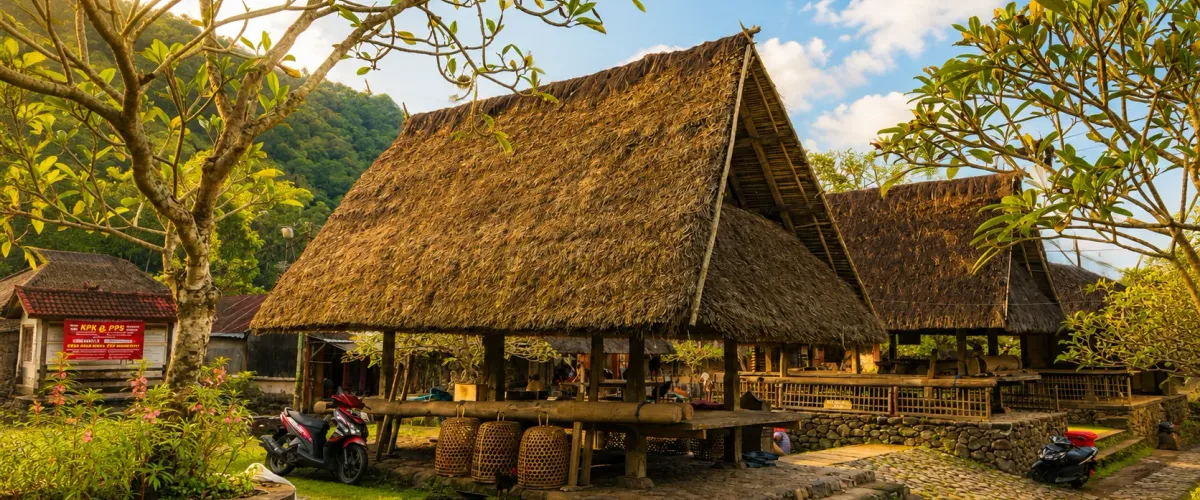
Tenganan

Tenganan

East Bali

Tenganan is not a tourist attraction cosplaying as a village. It is an actual community maintaining distinct traditions from pre-Hindu Bali. Located in East Bali, it is more remote and less visited than Ubud-area attractions [1]. You will see traditional weaving, distinctive architecture, and daily life organized by customs that outsiders are mostly observing rather than participating in.

Expect to spend 2-3 hours here. The visit is less about activities and more about observation. You can watch weavers at work, walk through the village, buy handmade textiles at source prices, and spend time in the quiet of a working community. There is no big spectacle. That is the point. Bring patience, respect for boundaries, and genuine interest in how people live.

Quick Facts

📍
Location
Karangasem district, East Bali. 70 kilometers from Denpasar, 60 kilometers east of Ubud. Situated in hilly terrain with rice field surroundings.
East Bali
🌿
Atmosphere
QuietCulturalRuralSpiritualTraditional
Best For
Solo TravelersPhotographers
✈️
From Airport
Drive to Denpasar area, then east toward Karangasem and Tenganan (1.5-2 hours). Or from Ubud, drive east through Gianyar toward Karangasem (1.5-2 hours). Most travelers hire a driver for the journey. Arrange through hotel.
📍 Tenganan on the Map
Loading map…

Why Visit Tenganan?

Tenganan appeals to travelers seeking authentic community experience, interested in textile arts, or wanting to understand pre-Hindu Bali traditions.

  • For Cultural Observers: Tenganan is one of few places where Bali Aga traditions are maintained and visible. You are not watching a performance. You are observing actual community life. The architecture, social organization, and daily practices differ notably from Hindu Balinese culture. Spending time here offers perspective on Bali cultural diversity.
  • For Textile Enthusiasts: Tenganan is known for double-ikat weaving (geringsing), where both warp and weft are resist-dyed before weaving [2]. The resulting patterns are complex and distinctive. Weavers work in their homes, and you can watch the process. Buying directly from weavers offers fair prices and genuine handmade items.
  • For Those Seeking Quiet and Authenticity: Tenganan has no tour bus infrastructure, no souvenir shops designed for tourists, and limited English. This means fewer visitors overall and a different energy than Ubud or south Bali. If you want to experience a place where tourism is secondary to community function, this works.
  • For Photographers Interested in Culture: The village architecture, weaving process, and daily activities offer visual interest without the Instagram-driven staging of more famous locations. Early morning light on houses and fields is beautiful. Just ask before photographing people.
  • For Architecture and Urban Planning Enthusiasts: The village layout reflects specific planning principles. Linear arrangement, house placement, public and private spaces. Understanding how communities organize themselves reveals assumptions embedded in the design.

Highlights

Key Aspects and Locations

Traditional Weaving

The most visible activity in Tenganan is weaving. Women work on traditional looms in small structures beside their homes, visible from the main street. The weaving process is slow and deliberate. A single scarf or sarong can take weeks. Double-ikat geringsing cloth requires even more time because both warp and weft must be resist-dyed before weaving [2]. Watching a weaver at work for even 15 minutes offers insight into the labor involved in handmade textiles. Many weavers sell directly. Scarves run 150,000-300,000 IDR, sarongs 300,000-800,000 IDR depending on size and complexity.

Bale Agung (Community Hall)

The main communal gathering space where community decisions are made and ceremonies are conducted. You may be able to see the structure from outside, though access depends on whether activities are happening. The hall is not a tourist facility. It is a working community space, and respect for that boundary is important.

Pura Tenganan (Village Temple)

The main temple serves the community. Visitors are welcome with appropriate dress (sarong and covered shoulders) during non-ceremony times. The temple architecture reflects Bali Aga style rather than Hindu Balinese design. You will see locals making offerings and maintaining the space. During ceremonies (which happen regularly), outside visitors observe from designated areas if invited by community members.

Houses and Village Layout

The distinctive architecture is worth observing slowly. Houses are built on raised platforms with specific structural methods. Walls, roofs, and gates reflect local building traditions. The linear arrangement and the spacing between compounds create a different feel from scattered Hindu Balinese villages. Walking the main street and observing architectural details (without entering private spaces) takes time but offers insight into how communities organize physical space.

Rice Fields and Agricultural Areas

Surrounding the village are rice fields where residents farm. These are not set up for tourists. They are working agricultural land. Walking to the edges of the village offers views of the landscape and sometimes encounters with farmers. The contrast between village and field is sharp. Within 100 meters you move from residential compounds to open farmland.

Small Shrines and Warungs

Throughout the village are small family shrines and a few basic warungs serving simple local food. These are not tourist restaurants. They are community gathering spots. Eating at a warung (if one is open when you visit) costs 30,000-60,000 IDR and gives you a sense of how residents spend daily time.

Things To Do in Tenganan

Activities and Strategies

Arrive Early and Walk Slowly

Come before 10:00 AM when the village is waking up and tour groups have not arrived. Walk the entire main street without rushing, observing house details, watching weavers, and noting how the space is organized. Early visits feel different. More like being in a place where people live, less like touring an attraction.

Watch Weavers at Work

Stop at looms visible from the street and watch for a few minutes. If a weaver seems open to interaction, ask (through a guide if needed) about the process. How long does a piece take? What are the dyes? What do the patterns mean? Many weavers enjoy explaining their work. You do not need to buy immediately. Watching the process itself is the point.

Buy Textiles Directly

If you want woven cloth, buy from a weaver rather than a shop. Prices are similar, but you support the maker directly. Ask about commissioning a piece if you want something specific. Turnaround is weeks, but it is a genuine connection. Inspect quality. Check weaving tightness, color evenness, and finishing. Good weavers are proud of their work and expect inspection.

Engage with Community Members

Greet people respectfully. Learn basic Indonesian greetings (Selamat pagi for good morning, Terima kasih for thank you). If someone is friendly and has time, a conversation (even if it requires hand gestures) offers human connection. Older residents sometimes speak English and enjoy sharing stories about the village. Younger people may be more reserved. Respect that boundary.

Visit the Temple with Permission

Ask at the entrance or through a guide if visitors can enter Pura Tenganan. During non-ceremony times, entry is usually allowed with proper dress. During ceremonies, ask a community member if outside visitors are welcome. The temple offers insight into religious practice and architecture, and community members appreciate genuine respect for the space.

Sit and Observe

Find a quiet spot (maybe on a bench, maybe on a step outside a warung) and simply observe for 30 minutes. Watch how people move through the space, interact, conduct daily tasks. This kind of observation reveals patterns. Morning rhythms, social interactions, how decisions get made. These are things that movement and activity photos miss.

Hire a Local Guide

A guide (arranged through your hotel or by asking in the village) costs 300,000-500,000 IDR for 2-3 hours. A good guide explains traditions, introduces you to community members (if they are willing), and provides historical context. They also manage respectful access to sites and activities that might otherwise be confusing to navigate as an outsider.

Best Places To Visit Nearby

  • Candidasa (coastal town, dive sites, 15 km southeast)
  • Goa Lawah - Bat Cave Temple (temple, 20 km west)
  • Taman Ujung Water Palace (royal palace, 25 km south)
  • Pura Besakih (mother temple, 35 km west)
  • Lovina (beach town, 45 km north)
  • Ubud (art galleries, culture, 60 km west)

About Tenganan

Tenganan: Bali's Living Heritage Village

Tenganan sits in the Karangasem district of East Bali, roughly 70 kilometers from Denpasar and about 60 kilometers east of Ubud [1]. The village is one of several Bali Aga settlements—communities that maintained distinct cultural practices before Hinduism became dominant in Bali, and who have preserved those traditions despite centuries of external change. Tenganan is the largest and most accessible of these villages, and it operates not as a museum but as an actual community where people live, work, farm, and practice traditions daily.

The village is organized in a linear pattern with houses arranged perpendicular to the main street [1]. The architecture is distinctive—traditional Bali Aga style with specific features that differ from Hindu Balinese design. Houses are built on raised platforms, walls are made from bamboo or wood with specific joinery methods, and roof designs reflect local building knowledge accumulated over centuries. The village has a central temple (Pura Tenganan) and communal spaces where community activities happen. There is no central marketplace—daily life operates through family compounds and shared spaces.

Bali Aga Traditions

Bali Aga means original Balinese, referring to communities that maintained distinct practices separate from Hindu-dominant Bali. Tenganan traditions include specific marriage customs, unique musical instruments, a calendar system based on traditional timekeeping, and weaving techniques found nowhere else in Bali [2]. Many Bali Aga practices are not performed for tourists. They are community activities conducted on their own schedule. Visiting during a ceremony (which happens regularly but unpredictably) offers glimpses of these traditions in context, though outsiders typically observe from a distance with permission.

The village maintains strict rules about community membership, outside marriage, and land ownership. You cannot buy property in Tenganan if you are not born there. Marriage outside the village requires specific processes. These rules preserve the community stability but also mean that outside influences are deliberately limited. The practical result is that daily life feels different from other Balinese villages. There is less commercial energy, fewer concessions to tourism, and a stronger sense of community governance.

Today, Tenganan faces the challenge that many traditional communities do: younger residents moving to cities for work, tourism pressure changing social dynamics, and economic pressure to commercialize. The village has managed this better than some places. They control visitor access, limit commercial activity, and maintain community autonomy. But the tension is visible if you pay attention.

References

  1. Tenganan - Bali Aga Village Geography and CultureWikipedia - Tenganan (June 2024)
  2. Double-Ikat Weaving (Geringsing) and Bali Aga TextilesUNESCO Intangible Heritage - Balinese Weaving (June 2024)
Pics: img bdf8dae5 af59 4d15 a466 e6e8bb67214f

🗓 Best Time to Visit

April to October (dry season) offers clear days and dry paths. November-March (wet season) brings green landscapes and fewer tourists. Visit early morning (before 10 AM) regardless of season. Weekdays are quieter than weekends. Avoid major Balinese holidays (Nyepi, Galungan) when ceremonies dominate. Any season works for village observation, but early morning timing is always best.

💡 Local Tips

Getting There: Tenganan is in Karangasem district, 70 kilometers from Denpasar (1.5-2 hour drive) and 60 kilometers east of Ubud (1.5-2 hour drive). Road signs point toward the village, and it is well-known locally. Hire a driver from your hotel or Ubud (negotiate 600,000-900,000 IDR for the day). By public minibus, take a bemo from Batubulan terminal in Denpasar toward Candidasa, ask to be dropped at Tenganan turnoff, then walk or hire a local minivan for the final 2-3 kilometers. Most travelers arrange through their hotel.

Entry and Donations: There is a suggested donation of 30,000-50,000 IDR per visitor to support community maintenance. This is not a hard fee. It is genuinely suggested. Pay at the entrance or ask where donations go. The money supports community facilities and preservation efforts. Some visitors give more, some less, depending on means and comfort.

Timing and Crowds: Arrive before 10:00 AM for the quietest experience. Tour groups from Ubud often arrive around 11:00 AM and stay 1-2 hours. Late afternoon (4:00-5:00 PM) is quiet again. Plan 2-3 hours minimum to avoid rushing. Best days are weekdays when fewer tourists come. Avoid visiting during major ceremonies unless specifically invited. Your presence would be intrusive during religious observances.

What to Wear and Photography: Dress modestly. Covered shoulders and knees show respect. If visiting the temple, you will need a sarong (usually provided). Bring water and sun protection. There is limited shade on streets. Photography is generally okay, but ask before photographing people, especially while they are working. Some people prefer not to be photographed. Respect that immediately. Never photograph ceremonies without explicit permission.

Language and Interaction: English is limited. Learning basic Indonesian phrases helps. Greetings (Selamat pagi, Terima kasih, Apa kabar) go a long way toward friendly interaction. Older residents may speak some English. Younger ones are less likely. Smiling, moving slowly, and showing genuine interest communicate respect across language barriers.

What to Buy: Woven cloth is the main product. Scarves, sarongs, wall hangings. Quality varies. Good pieces are tightly woven with even dye. Bad pieces are loose, with uneven color. Buy from weavers when possible. Prices are fair and you support makers directly. Avoid mass-produced items in shops that pretend to be from Tenganan (you can often tell by inconsistent quality). Consider commissioning a custom piece if you have time.

Food and Facilities: There are no restaurants in the tourist sense. Basic warungs serve rice dishes, noodles, and drinks. A meal costs 30,000-60,000 IDR. Facilities are minimal. A few public toilets exist, though privacy is limited. Use a toilet before arriving if possible. Bring sufficient water. The village has limited supplies for visitors.

Best Seasons: Any season works. Dry season (April-October) offers clearer light and dry paths. Wet season (November-March) brings green fields and fewer tourists. Ceremonies happen throughout the year unpredictably. Ask at your hotel if any are scheduled during your visit. Attending a ceremony (with permission) offers context that casual visiting does not provide.

What to Avoid: Do not enter homes or private spaces without explicit invitation. Do not photograph ceremonies without permission. Do not expect English or tourist amenities. Come prepared for minimal infrastructure. Do not treat the village as a museum. Remember people actually live here. Do not haggle aggressively on woven cloth prices. Makers deserve fair compensation for labor. Do not visit during ceremonies unless specifically invited by community members.