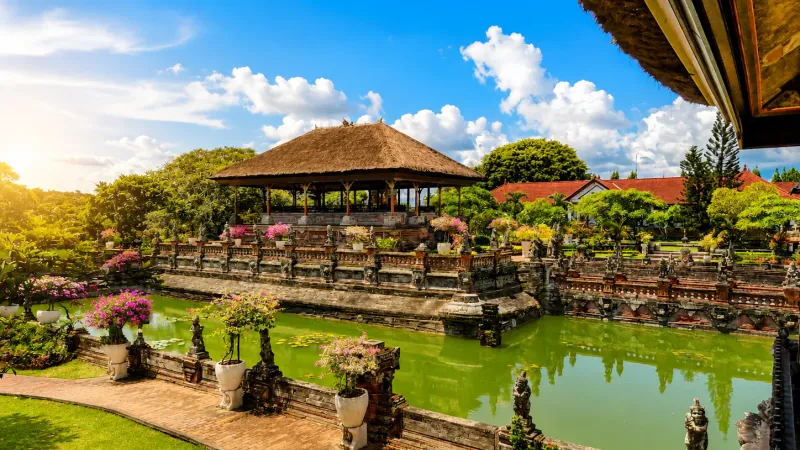
There's something about walking into Kertha Gosa that catches you off guard — and it usually happens the moment you look up. Right in the middle of Semarapura town in Klungkung, this open-air pavilion has been standing since 1686, and the ceiling is unlike anything else you'll find in Bali. Every panel is filled with intricate Kamasan-style paintings — vivid, layered, and packed with stories of gods, demons, punishment, and paradise. It's the kind of place that makes you stop mid-sentence just to stare.
The Story Behind the Pavilion
Kertha Gosa was built during the reign of the Klungkung Kingdom, and the name itself roughly translates to a place to discuss peace and well-being. But don't let that gentle name fool you — this was actually the royal court of justice, where Brahmin judges and high priests settled disputes brought before the kingdom.
The ceiling paintings weren't just decorative. They were strategic. Anyone who came before the court to testify or be judged would look up and see vivid scenes of sinners being tortured in hell — boiled, bitten by snakes, dragged by demons — right alongside images of the righteous enjoying peaceful heavenly realms. It was a visual oath enforcer, essentially. Lie in this room, and you're looking at your own fate painted above your head.
The Kamasan Ceiling — What You're Actually Looking At
The paintings follow the Kamasan style, a traditional form of Balinese painting that comes from the village of Kamasan in Klungkung — just a short drive away. The style uses natural pigments, fine line work, and a flat, two-dimensional perspective with incredibly intricate detail.
The main narrative depicted across the ceiling panels comes from the Bhima Swarga — a tale about the Mahabharata hero Bhima descending into the underworld to rescue his parents' souls. You'll see layered scenes moving outward from the center: punishments in the lower realms, transitional planes, and eventually the upper realm where the virtuous rest in peace. There are also cosmological depictions showing the Balinese Hindu view of the universe and cycles of existence.
Some of the panels were restored in the early 20th century when Dutch colonial administration took over the area, so what you see is a mix of original and restored work. That said, the skill and detail — even in the restored sections — is genuinely impressive.
The Taman Gili Complex
Your entrance ticket covers the full Taman Gili complex, which means you're not just getting Kertha Gosa. Taman Gili translates to island garden, and the complex is surrounded by a moat — giving the whole place a peaceful, semi-secluded feel despite sitting right in the middle of a busy town.
Inside you'll also find the Bale Kambang, the floating pavilion set over the water, decorated with its own beautiful artwork. There's a small museum on-site as well with artifacts and information about the Klungkung Kingdom, including context around the 1908 Puputan Klungkung — a final, tragic uprising against Dutch colonial rule where the royal family walked into battle rather than surrender.
Getting Here and What to Expect On-Site
Kertha Gosa is right on the main road in Semarapura, so you genuinely cannot miss it. From Ubud it's roughly 45 minutes to an hour. From the Kuta or Seminyak area, budget around 1.5 to 2 hours depending on traffic. Parking is available nearby.
The complex is fairly compact — most visitors spend between one and two hours here comfortably. Mornings are the sweet spot, ideally before 10 AM, when it's cooler and less crowded. Dress modestly; a sarong is expected (and may be provided at the entrance). Klungkung gets hot quickly, so sunscreen and water are worth bringing if you're visiting later in the day.
Pairing It With the Surrounding Area
Klungkung sits at a convenient crossroads in Bali. After Kertha Gosa, you're well placed to head northeast toward Sidemen Valley and its rice terrace views, east toward Candidasa or Padang Bai, or up toward Besakih — Bali's most important temple complex. The traditional market in Semarapura is also worth a quick walk through for local snacks and textiles before you leave.